
By Gemma Jiang and Joanna Kaniewska.

2. Joanna Kaniewska (biography)
How can teams develop a mindset that makes differences productive, such as disciplinary differences in work processes, communication styles, underlying assumptions, behavioral norms, and more? In particular, how can teams move from an either/or mindset, which often leads to defensiveness driven by the need to prove that “I am right; you are wrong” to a both/and mindset, which fosters a learning culture in which differences become sources of generative tension that can propel creativity and collective insight?
One practical way to cultivate a both/and mindset is through working with polarities which are opposing yet interdependent tendencies. By integrating both tendencies, teams can move beyond either/or thinking and draw on a wider range of perspectives. We argue that developing the capacity to navigate polarities helps teams navigate differences more effectively overall.
In this i2Insights contribution, we describe three limiting beliefs drawn from our experience with team science coaching and show how they can be transformed through polarity thinking.
1. Limiting Belief: “If I do not defend my ideas, then I do not really mean it.”
Underneath this belief is an overattachment to advocacy and assuredness. Individuals may feel that staying firm, certain, and persuasive is necessary to demonstrate competence and commitment. This is attributable to the highly intellectual and achievement-oriented science environment where expertise and credibility are closely tied to one’s ideas.
Yet when advocacy becomes overemphasized without inquiry, and assuredness is over-practiced without openness, collaboration can become defensive and positional. Team members may spend more energy protecting their perspectives than learning from one another. Curiosity narrows, listening weakens, and opportunities for collective insight diminish.
Polarity thinking invites a more expansive stance. Rather than considering advocacy and inquiry as opposites to choose between, they are seen as interdependent tendencies that strengthen one another. The same applies to assuredness and openness. Standing firmly in a perspective does not require closing oneself off from being influenced by another. Instead, openness can allow ideas to evolve through dialogue and shared sensemaking, leading to even stronger ideas that can be held with deeper conviction.
The transformed belief—“I can stand firmly in what I believe and stay open to being changed by what I hear”—reflects a both/and mindset that supports learning, adaptability, and stronger collaboration across differences.
2. Limiting Belief: “If I give constructive feedback, then I am not nice.”
This belief commonly appears among team science practitioners who deeply value harmony, care and positive relationships. It results from an overattachment to maintaining relationships and empowerment. People operating from this mindset may avoid difficult conversations out of concern for hurting others, damaging trust, or appearing overly critical.
However, when relationship is emphasized without considering the tasks at hand and empowerment is practiced without providing direction for team members, important tensions and developmental opportunities often remain unspoken. Teams may experience unresolved frustration, unclear expectations, or reduced accountability. Over time, the absence of honest feedback can weaken collaboration.
Polarity thinking reframes this tension by recognizing that care and candor are not mutually exclusive. Honest feedback, when offered skillfully and compassionately, can be an expression of respect, investment, and commitment to another person’s growth.
The transformed belief—“I can care deeply and speak honestly so that feedback is an act of love”—reflects a both/and mindset that integrates compassion with accountability, allowing teams to build greater trust, learning, and resilience.
3. Limiting Belief: “If I tend to my own needs, then I am not leading.”
This limiting belief can occur among highly committed science leaders who consistently prioritize the needs of the group over their own. They over-identify with being supportive and indispensable, so that good leadership becomes equated with continual self-sacrifice. Attending to personal needs may then feel selfish or at odds with serving others.
While this orientation often stems from genuine care and dedication, it is rarely sustainable. In practice, such leaders burn out, while unintentionally limiting the growth and agency of their team members.
Polarity thinking reminds us that effective teams benefit not only from leaders who support and care for others, but also from leaders who are grounded, self-aware, and sustainable in their engagement. Such leaders create space for both support and challenge, encouraging team members to step into greater ownership and capacity themselves.
The transformed belief—“Self-care and service are two expressions of the same love”—reflects a both/and mindset that honors both individual wellbeing and collective contribution.
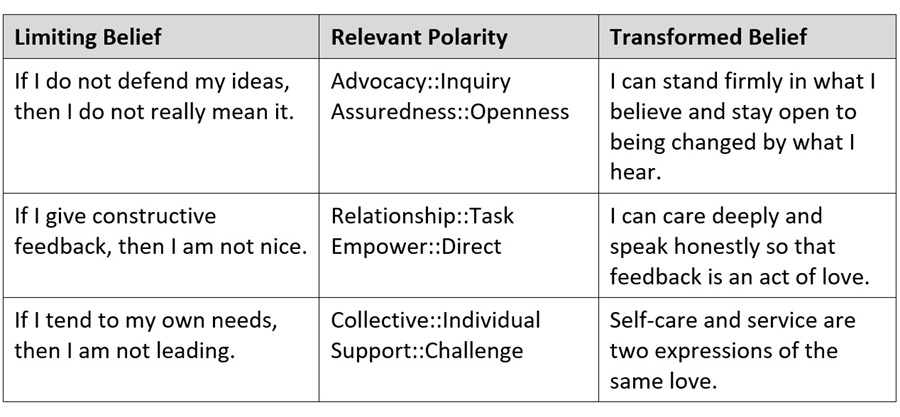
These three shifts away from limiting beliefs, as well as the relevant polarities involved, are summarized in the table below.
| Limiting Belief | Relevant Polarity | Transformed Belief |
|
If I do not defend my ideas, then I do not really mean it. |
Advocacy::Inquiry |
I can stand firmly in what I believe and stay open to being changed by what I hear. |
|
If I give constructive feedback, then I am not nice. |
Relationship::Task |
I can care deeply and speak honestly so that feedback is an act of love. |
|
If I tend to my own needs, then I am not leading. |
Collective::Individual |
Self-care and service are two expressions of the same love. |
Polarities that can transform limiting beliefs (In the table “::” is called a “paradot,” a new punctuation mark created to represent the paradoxical relationship between the two tendencies of a polarity, namely opposing and interdependent.) (For those using small screens, please note: this is a three column table and columns that flow off the right-hand side of the screen can be scrolled to. An image version of this table is also available).
Conclusion
As Niels Bohr suggested (Rozental, 1967), deep truths work differently from correct statements—they often appear as opposites, yet both may reveal essential aspects of reality. Polarity works exactly this way, with both tendencies holding important truths, and long-term success depending on the ability of teams to engage and integrate both tendencies.
What has your team’s experience been in navigating polarities? How have you and your team transformed differences from sources of defensiveness into generative tensions that foster creativity, learning, and deeper collaboration?
Reference:
Rozental, S. (Ed.). (1967). Niels Bohr: His life and work as seen by his friends and colleagues. North-Holland Publishing Company: Amsterdam, Netherlands.
Use of Artificial Intelligence (AI) Statement: OpenAI’s ChatGPT-5.5 was used to help brainstorm wording for the transformed belief statements. (For i2Insights policy on artificial intelligence please see https://i2insights.org/contributing-to-i2insights/guidelines-for-authors/#artificial-intelligence.)
Biography: Gemma Jiang PhD is senior team scientist at the Institute for Research in the Social Sciences (IRISS) at Colorado State University in Fort Collins, Colorado, USA. She applies complexity leadership theory, social network analysis, and a suite of facilitation and coaching methods to enable cross-disciplinary science teams to converge upon solutions for challenges of societal importance.
Biography: Joanna Kaniewska PhD is founder of T Shaped, a coaching and consulting practice based in New York City, New York, USA. She draws on over 15 years of experience across academia, industry, and the advocacy sector to support science leaders and teams in strengthening collaboration, communication, and decision-making through evidence-based facilitation, training and coaching.
This i2Insights contribution is based on a workshop Navigating Polarities: Developing Both/And Leadership in Team Science run by the two authors at the 2026 Science of Team Science Conference, held in May in Vancouver, Canada.
Funding Acknowledgement: This i2Insights contribution was supported, in part, by the National Center for Advancing Translational Sciences of the United States National Institutes of Health under Grant Number UM1TR004548. The content is solely the responsibility of the authors and does not necessarily represent the official views of the National Institutes of Health.
Thank you Gemma and Joanna, I appreciate your thoughtful and well-grounded contribution. This brings me back to my 2020 i2Insights post on managing paradoxical tensions toward negotiating a shared understanding https://i2insights.org/2020/11/17/navigating-paradoxes/.
Great to see how much our frameworks have common and how yours extends on practical and psychological levels. I notice how we both identify the generating energy that exists between competing tendencies rather than viewing them as problems that need fixing. Your post gives a very personal explanation of why teams oppose that change, attending to the limiting beliefs on self-sacrifice, defensiveness, and niceness – this gives the both/and shift a psychological ‘safe space’ to land, which in my view, is often missing from more abstract interpretations of paradox. Your reference to Bohr (along with the reference to Stacey in mine) highlight the reality of tension as a creative and integrative state rather than a failure, linked to the long-term success of teamwork. I think the ‘paradot’ (::) is a beautiful addition that really helps show the interdependence of elements on the page.
From my personal experience, I would add that before teams can perform the belief-reframing efforts you describe here, they often need to be able to recognise and accept that a tension is truly unresolvable, before moving into a ‘workable certainty’ – a concept from Lüscher, L. S. and Lewis, M. W. (2008). Organizational change and managerial sensemaking: Working through paradox. Academy of Management Journal, 51, 2: 221-240.). In the absence of that kind of epistemic work-through and gaining team approval, altered beliefs may feel less like hard-won insights. I wonder whether your workshop addresses this kind of sequencing (recognition/acceptance of the tensions themselves before reframing) and if it does, how?
Once again, thank you both for taking this discussion in such a thoughtful and useful direction.
Hi, Faye, thank you so much for this thoughtful comment and for pointing me to your 2020 post. I thoroughly enjoyed reading it and discovering so much resonance between our approaches.
Your question about sequencing is an important one. In practice, I have found that people’s relationship with tension is often mediated by power. Some individuals, particularly those in power positions, may not experience a tension as unresolvable because, throughout their personal and professional history, they have been able to override it by choosing one pole over another. If I have the authority to impose a decision, the tension can appear to disappear. From my perspective as a leader, I may conclude that the matter has been settled. Yet those whose preferred pole has been overridden continue to experience the tension quite acutely.
This observation has led me to wonder whether power can sometimes insulate us from the experience of polarity. The downsides of over-favoring one pole often emerge gradually and at a distance from the original decision, making them less visible to those with the greatest power. The delayed feedback system in nonlinear systems is partially responsible. Power can delay the recognition that a tension remains alive beneath the surface. The result is often a pendulum swing, where teams alternate between poles without ever examining the assumptions that keep generating the cycle.
For this reason, I often introduce polarity as a feature of reality itself. I place it in the same category as gravity. Gravity does not require our belief in it, nor is it subject to our free will. We can ignore it for a while, but not indefinitely. The more we understand how gravity works, the more agency we have in working with it. In a similar way, polarity thinking helps us recognize and work with forces that already exist. Polarity thinking did not invent the tension. Once people begin to see these tensions as natural, recurring, and inseparable aspects of reality rather than signs of failure, the reframing process tends to become much more accessible.
I sometimes invite people to look for polarities in their daily lives before applying the concept to organizations. I recently wrote a short reflection on this topic that may be of interest: https://www.linkedin.com/posts/gemma-jiang_paradoxicalthinking-powerofpolarity-share-7470145712748568577-54v3/
Thank you again for engaging so deeply with our work. Your comment has given me a new way to think about the relationship between recognition, acceptance, power, and polarity.
Thank you, Gemma. Your gravity metaphor is elegant and disarming, with resistance dissolved by inviting people to notice what is already there rather than asking them to change.
Your observation about power is particularly telling. If power enables one to avoid recognising the unresolvable nature of a tension, since such an individual has always had a history of being able to resolve it, it may explain why polarity work will yield different results based on one’s relative position within a hierarchy.
I would add tentatively that establishing the conditions where a tension is recognised by the whole group may itself require some prior relational work. Perhaps recognition of tension is not only a cognitive act but a relational one, requiring that everyone in a given group experience it as live and unresolved, and not just those who find their favoured pole being overridden.
This connects back to my earlier point about sequencing, and suggests that the recognition and acceptance of tension may need to precede the reframing work, particularly in groups where power has allowed some members to remain insulated from feeling the tension at all.
I look forward to reading your LinkedIn reflection. Thank you again for generously sharing your experiences, and likewise, this exchange is giving me new ways to think about these relationships and practices.
Dear Faye,
I really appreciate your point that establishing the conditions in which a tension is recognized by the whole group may itself require significant prior relational work. Most of my polarity work has been either in 1:1 coaching settings, where individuals bring a challenge and gain new insight through the polarity lens, or in workshop settings where participants have voluntarily chosen to attend and therefore already have some openness to the approach. Working with a group whose members have varying degrees of openness—or resistance—to the concept is a learning edge for me. Thank you for pointing that out.
At the same time, I do want to offer a slightly different perspective. While people in positions of power may be sheltered from certain tensions, they are not always in positions of power in every aspect of their lives, nor do they always feel in control. In other domains, they may have experienced similar tensions firsthand: the self::other tension with a spouse, the inquire::advocate tension with siblings, or the hope::reality tension while navigating health challenges.
This is also part of why I often describe polarities as being more like gravity than a choice. No one can completely escape gravity. Astronauts may experience temporary freedom from it in outer space, but that is the exception, not the norm. Gravity remains a fundamental condition whether we notice it or not.
I see polarities in a similar way. People may be shielded from experiencing a particular tension because of their position, privilege, or circumstances, but that does not mean they are free from polarity altogether. The same dynamic often shows up elsewhere in their lives. They may not experience the tension between self and others in their leadership role, but they may encounter it in their marriage. They may not feel the tension between inquiry and advocacy at work, but they may feel it with family members. The specific manifestation changes, but the underlying reality remains.
Perhaps the challenge is not whether people experience polarity, but whether they recognize it. Making those experiences more visible and building explicit connections to them might help people engage with polarities in a more embodied way, beyond a purely cognitive understanding. That said, this may require prior 1:1 work before bringing people together in a group setting, as you suggest.
Great points!
Gemma
Thanks, Gemma. That’s a great key insight – polarity that stays hidden in one area, like work, while showing up unguarded elsewhere in a person’s life, is a useful way to think about helping people discover polarity in their personal experience before bringing it into the team context. It’s almost a paradox in that the same person might find polarity already resolved in one sphere of life, while being fully live in another sphere, because something about that context shields the person from having to face it – a bit like your astronaut, for whom gravity is delayed, not avoided.
I wanted to add something about moving the question from whether someone experiences polarity to whether they recognise it, and also maybe more importantly, accept it. Someone can recognise that a tension exists but simply view it as a problem waiting to be fixed, rather than accepting it as something to live with in an ongoing way. This is closer to what was meant by the state of ‘workable certainty’ mentioned in my earlier comment. Recognition can open the door; acceptance can allow someone to actually walk through it.
I wonder if you have a go-to exercise or prompt for surfacing polarities that exist elsewhere in someone’s life, to help them understand how they might play out in the team?