
By Allison Dalton, Yvonne Pelling and Gaetano R. Lotrecchiano.

2. Yvonne Pelling (biography)
3. Gaetano R. Lotrecchiano (biography)
How can teams demonstrate accountability in two different collaborative environments?
Accountability refers to the ways, both tangible and intangible, of showing up for ourselves and the rest of the team throughout a collaborative project. It gives rise to trust and forward momentum which impacts team functioning and ultimately the outcome of the work.
Here we look at accountability in two different collaborative environments, which we refer to using the metaphors of the jigsaw puzzle and the collage.
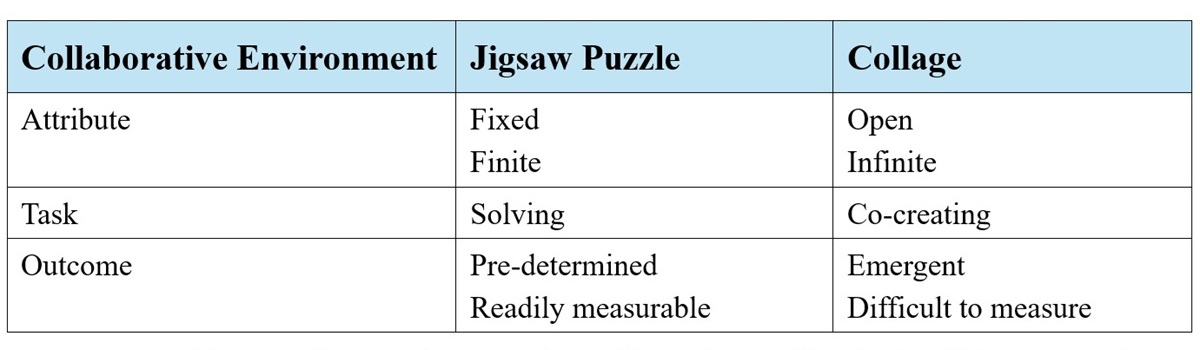
A team tasked with assembling a jigsaw puzzle deals with a finite set of clearly distinguished pieces, each to be fitted together in one correct way, and a reference image to demonstrate what the outcome will look like. Jigsaw puzzle teams work in unchanging environments with clearly measurable success criteria. Accountability in these environments is relatively straightforward (although not necessarily easy).
A team tasked with co-creating a collage is given only starting materials and a blank canvas, and must conceptualize, define, execute, and continually renegotiate the vision as the collage takes shape. Collage teams work in shifting, relational, and open environments where success is established rather than imposed. Accountability in these environments is neither straightforward nor easy.
The two environments are summarized in the table below.
| Collaborative Environment | Jigsaw Puzzle | Collage |
|
Attribute |
Fixed |
Open |
|
Task |
Solving |
Co-creating |
|
Outcome |
Pre-determined |
Emergent |
(For those using small screens, please note: this is a three column table and columns that flow off the right-hand side of the screen can be scrolled to. An image version of this table is also available).
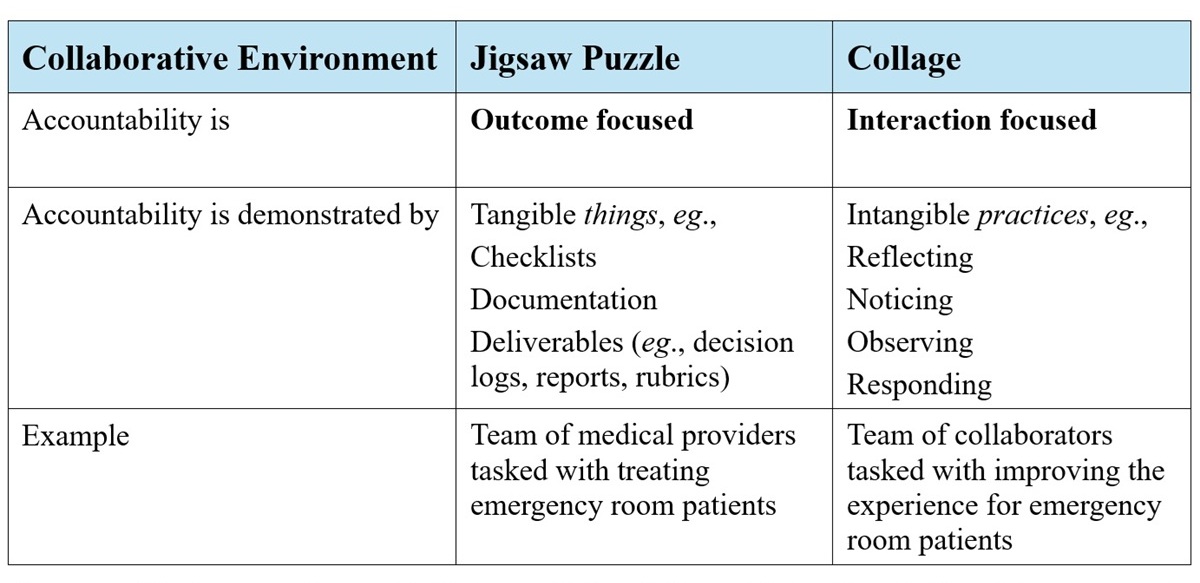
Accountability in a jigsaw puzzle environment can be demonstrated with tangible things like checklists and clear documentation, with deliverables centered on rubrics and reports. An example is a hospital emergency room, where medical care providers are tasked with treating patients. Providers contribute their differing expertise to assess, diagnose, and treat the patient according to established care guidelines.
Accountability in a collage environment requires multiple perspectives to be understood and integrated. For this type of process, although the team may be inclined to reach for a checklist, the team will find that none exists or that available checklists are limited in their applicability. Accordingly, the emphasis of accountability becomes less outcome focused, and more interaction focused. Accountability in this environment could look like observing the situation, being reflective, and taking different perspectives in real time. This translates into questions like:
- Am I listening fully?
- Do I give and take space?
- How am I contributing to a positive and forward moving environment?
- Do I create safety for others?
An example is a hospital team―including medical providers, hospital staff, and patient partners―tasked with understanding and improving the experience for patients receiving care in the emergency room. In this environment, the collaborators contribute their differing expertise, but the path forward is undefined.
These two kinds of accountability are summarized in the table below.
| Collaborative Environment | Jigsaw Puzzle | Collage |
|
Accountability is |
Outcome focused |
Interaction focused |
|
Accountability is demonstrated by |
Tangible things, eg., |
Intangible practices, eg., |
|
Example |
Team of medical providers tasked with treating emergency room patients |
Team of collaborators tasked with improving the experience for emergency room patients |
(For those using small screens, please note: this is a three column table and columns that flow off the right-hand side of the screen can be scrolled to. An image version of this table is also available).
Conclusion
As teams work through challenges, they must first understand the type of collaborative environment they inhabit before they can understand how to demonstrate accountability to each other and to the work. Neither the jigsaw puzzle nor the collage is inherently more valuable and, commonly, collaborations incorporate both at different times. Accordingly, teams can strive to flexibly demonstrate accountability using both outcome and interaction-focused methods.
Do these metaphors resonate with you? What are your experiences in jigsaw puzzle and collage environments? How do you shape accountability in each environment?
Use of Artificial Intelligence (AI) Statement: Anthropic’s Claude Sonnet 4.5 was used for the purposes of brainstorming, providing feedback, editing, and proof-reading. All content, conceptualization, and writing came from the authors. (For i2Insights policy on artificial intelligence please see https://i2insights.org/contributing-to-i2insights/guidelines-for-authors/#artificial-intelligence.)
Biography: Allison Dalton MSHS is a PhD candidate in Translational Health Sciences at the George Washington University School of Medicine and Health Sciences in Washington, DC, United States of America. Her research draws from complex systems science, system dynamics, and team science to explore how inter- and transdisciplinary teams integrate diverse perspectives in research.
Biography: Yvonne Pelling MEd is the Patient and Community Partnership Lead at PASSERELLE, Canada’s national training entity in Patient-Oriented Research, in Quebec. Her work examines how people learn to collaborate across disciplines, sectors, and forms of expertise, with research interests in team science, patient-oriented research, inter- and transdisciplinary collaboration, and collaborative capacity-building.
Biography: Gaetano R. Lotrecchiano EdD, PhD, FINSciTS is a Professor of Clinical Research and Leadership and of Pediatrics at the School of Medicine and Health Sciences at George Washington University in Washington, DC, United States of America, and is a Senior Fellow of the International Network for the Science of Team Science. His research interests include complexity leadership and characteristics, transdisciplinary team science, team science competencies and motivation in teams.
Fascinating concept that helps better understand teaming dynamics. Thank you!
Thanks Darius, glad to hear you found it helpful!
Very interesting dynamic perspectives: “Jigsaw” versus “Collage” intersectionality in Team Science project. While they have distinct connotations but at the same time go hand in hand with the most efficient outcome goal. Jigsaw strategy may appear to be daunting at first but with clear well-thought-out methodological systematic approach raises the comfort level of participating collaborators in this project; however, Collage may appear very straight forward logical thinking at first glance but may have inherent intricacies in personalities dynamics across various disciplines, mindset, priorities. Although both approaches are very pragmatic and can suit different personalities who are either go getters to accept challenges while laid back may get chance to mull over thoughtful discussion and pay attention and give due credence to varied subject matter experts in the team. Both are valid approaches that can be fine tuned to apply withing defined group settings. Kudos to authors for great provocative thought process in generating these two scenarios in accomplishing team science projects.
Hello Anil, thanks for your comment, you make an interesting point about personality types. How have personality dynamics showed up in your work?
Yvonne & Allison
Thanks Yvonne and Allison, Personality type is a very critical component in group dynamics, when we ask subject matter experts (SMEs) from various disciplines to come together for this Trans-disciplinary group activity of problem solving, we have to cater to the needs of individual personality types, some are extroverts, some are introverts, some are comfortable in giving their input right away to gauge the response from other participating members in this group activity, if they feel their input and feedback was not valued enough, they will just become observers, we have to find the inherent traits of people in group dynamics, their level of comfort in engaging others for this common goal, egos can get hurt inadvertently while having a candid conversations among members and that can disengage active participation and contribution from that person. S/he can show superficial participation while withholding critical innovative novel skills that s/he may have gained over the years and if they feel their problem solving skill sets are brushed aside very politely, they will become hesitant in sharing their time tested knowledge with others. Also in the group dynamics of problem solving through jigsaw or collage format, it is important to set the expectations, credit sharing and guidelines up front so that it is absolutely clear to everyone that their feedback in appropriately valued and cherished by everyone. Paying attention to these nuances can either expedite or delay the final outcome of this problem solving exercise. Thanks again, Anil
Hi Anil, thanks for such a thoughtful reply! We like how you pointed out how these relational dynamics play out over time. For example, you mentioned how team members may become disengaged. You’re right that these nuances cannot be overlooked!