
By Julia E. Moore and Sobia Khan.

2. Sobia Khan (biography)
What are some useful ways of thinking about trust when developing plans to implement your research or strengthen your team? More importantly, what are some practical ways to build trust both as an individual and as an organisation?
Indeed, when asked about some of the most challenging parts of implementing changes and taking part in research collaborations, people often talk about trust. Trust is essential for equity and for working with people in effective ways, but so few of us are trained in how to build trust.
This i2Insights contribution provides a practical approach to thinking about trust, along with actionable steps to cultivate trust to help you achieve your goals, whether you are working with others to implement evidence or looking to strengthen your team dynamics.
Setting the stage to build trust
Before jumping to actions to build trust, it’s so important to start by understanding the relational context, which includes factors such as previous experiences, historical and social context, the environment, and power. Some initial questions to explore this relational context include:
- What is the “thing” you are trying to address?
- What is the stage of your relationship with those you are collaborating with or want to influence (eg., new, established, tense)?
- How would you rate that relationship in terms of the current level of trust?
- What contextual factors might be impacting trust (eg., history, power dynamics)?
The key to building trust is to start from a place of deep reflection: What level of trust do we need to implement the “thing” we are trying to implement, and why is our level of trust currently what it is?
Why we trust people (and they trust us)
To continue with deep reflection, a model can be used to help us understand the “why” of trust – why do people trust us, and why do we trust others? We find it helpful to use The Trust Trifecta, shown in the figure below, to unpack trust. In this model, trust is made up of three components:
- Authenticity: We trust people when we think they are showing up authentically (eg., sharing their motives, being vulnerable, and having integrity).
- Competence: We trust people when we think that they have the knowledge and skills to do what they are being asked to do (ie., they have the ability to do it) and when we believe they think we are competent.
- Connection: We trust people more when we feel a sense of connection with them.

It is often some combination of these three components that creates trust. For example, many of your work relationships might rely on competence to build trust, and these relationships deepen when you establish connection and authenticity. Many of our personal relationships heavily leverage connection to build trust. When working with new partners, we may want to show up with connection but also authenticity to demonstrate that we mean what we say and share similar values in the work. You can use The Trust Trifecta to unpack why there might be a lack of trust or ways in which you can enhance trust in your relationships.
Actions to cultivate trust
Building on your reflections, you can then identify actions that can help you build trust— actions to express authenticity, competence, and connection.
The Cultiv8 tool helps people navigate this process at both the individual and organizational levels.
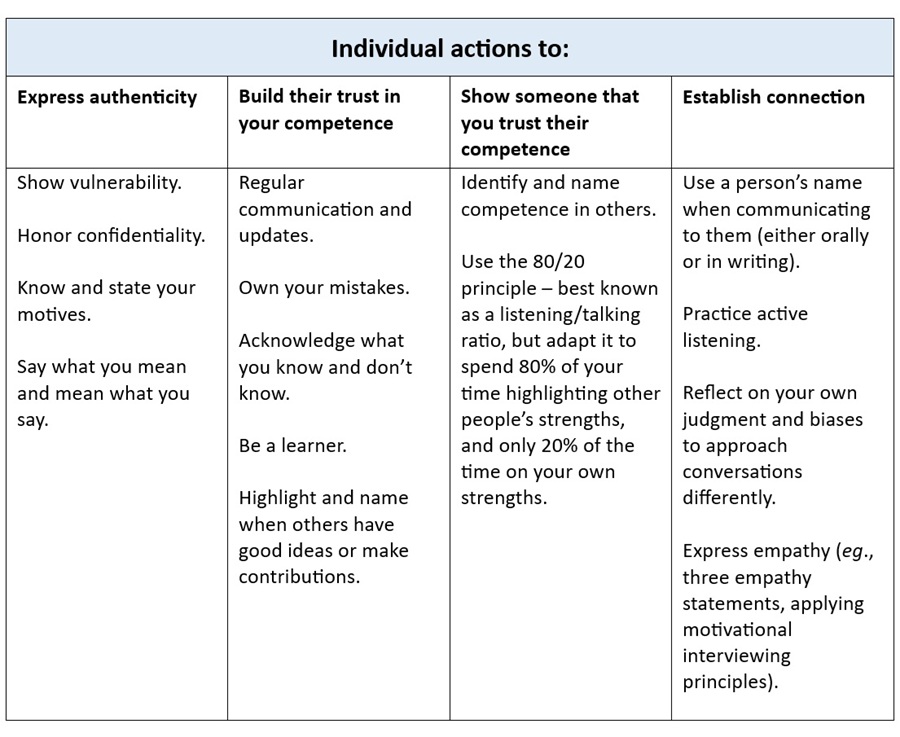
Here are some examples of the actions you can take to build trust at the individual level.
| Individual actions to: | |||
|---|---|---|---|
| Express authenticity | Build their trust in your competence | Show someone that you trust their competence | Establish connection |
|
Show vulnerability. Honor confidentiality. Know and state your motives. Say what you mean and mean what you say. |
Regular communication and updates. Own your mistakes. Acknowledge what you know and don’t know. Be a learner. Highlight and name when others have good ideas or make contributions. |
Identify and name competence in others. Use the 80/20 principle – best known as a listening/talking ratio, but adapt it to spend 80% of your time highlighting other people’s strengths, and only 20% of the time on your own strengths. |
Use a person’s name when communicating to them (either orally or in writing). Practice active listening. Reflect on your own judgment and biases to approach conversations differently. Express empathy (eg., three empathy statements, applying motivational interviewing principles). |
(For those using small screens, please note: this table is four columns wide and columns that flow off the right-hand side of the screen can be scrolled to. An image version of this table is also available.)
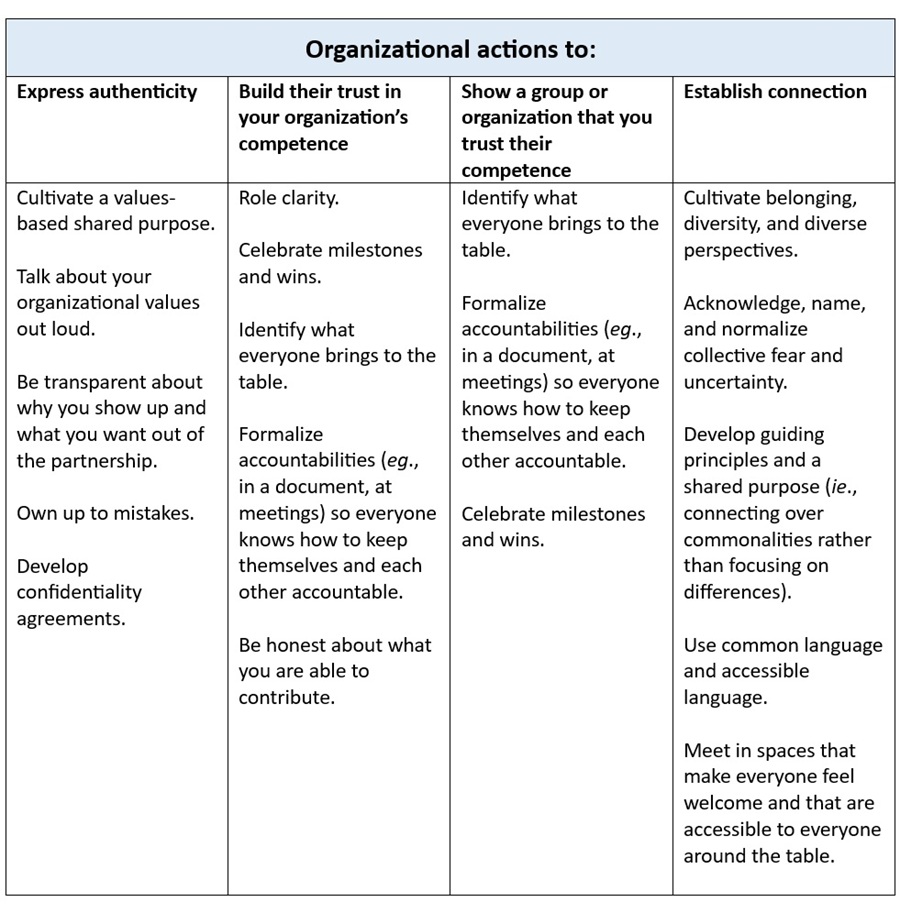
If you are looking for actions to build trust between groups or organizations, here are some examples.
| Organizational actions to: | |||
|---|---|---|---|
| Express authenticity |
Build their trust in your organization’s competence |
Show a group or organization that you trust their competence |
Establish connection |
|
Cultivate a values-based shared purpose. Talk about your organizational values out loud. Be transparent about why you show up and what you want out of the partnership. Own up to mistakes. Develop confidentiality agreements. |
Role clarity. Celebrate milestones and wins. Identify what everyone brings to the table. Formalize accountabilities (eg., in a document, at meetings) so everyone knows how to keep themselves and each other accountable. Be honest about what you are able to contribute. |
Identify what everyone brings to the table. Formalize accountabilities (eg., in a document, at meetings) so everyone knows how to keep themselves and each other accountable. Celebrate milestones and wins. |
Cultivate belonging, diversity, and diverse perspectives. Acknowledge, name, and normalize collective fear and uncertainty. Develop guiding principles and a shared purpose (ie., connecting over commonalities rather than focusing on differences). Use common language and accessible language. Meet in spaces that make everyone feel welcome and that are accessible to everyone around the table. |
(For those using small screens, please note: this table is four columns wide and columns that flow off the right-hand side of the screen can be scrolled to. An image version of this table is also available.)
Trust and power are intrinsically connected
Trust is not built or maintained without considering power dynamics. Therefore, it’s very important to consider how power is contributing to trust in an ongoing way. As part of the Cultiv8 tool, we also deal with power dynamics and you can learn more about this in a companion i2Insights contribution at https://i2insights.org/2026/03/19/navigating-power/.
Conclusion
Trust is foundational for implementing change since all implementation efforts are a social process involving people working with one another. Trust influences how people show up, how they engage, what they contribute, and how they feel during the process. Trust is also an essential part of equitable implementation.
Cultivating trust is an ongoing activity. Every time we interact with others, we have the opportunity to build trust. After deep reflection, you can consider what actions you can take to build trust and the Cultiv8 tool can help you explore options.
Do the ideas and actions presented here resonate with you? Does the Cultiv8 tool provide practical ways of building trust that would work for you? Do you have additional ideas or useful actions to add? Are there experiences of building trust that you can share?
To find out more:
Visit the Cultiv8 tool online at: https://thecenterforimplementation.com/cultiv8-tool
The Center for Implementation has also held free webinars on the Cultiv8 tool. Sign up to access the recordings:
- From Insight to Action: Tools that Support Implementation – Event #1: Cultiv8 tool (22 January 2026). (Online): https://thecenterforimplementation.com/implementation-tools-event-series
- Cultiv8 Collaboration: Fostering Change Through Trust and Power (23 January 2024). (Online): https://thecenterforimplementation.com/events/#cultiv8-collaboration-event
References:
Brown, B. (2021). Dare to lead: The braving inventory. Leaflet, Brené Brown website. (Online – open access): https://brenebrown.com/resources/the-braving-inventory/
Frei, F. X. and Morriss, A. (2020). Begin with trust. Harvard Business Review, (May–June 2020), 98, 3: 112-121. (Online): https://hbr.org/2020/05/begin-with-trust
Use of Generative Artificial Intelligence (AI) Statement: Generative artificial intelligence was not used in the development of this i2Insights contribution. (For i2Insights policy on generative artificial intelligence please see https://i2insights.org/contributing-to-i2insights/guidelines-for-authors/#artificial-intelligence.)
Biography: Julia E. Moore PhD is the Executive Director of The Center for Implementation, based in Canada. She has worked closely with provincial, national, and international organizations to strengthen their knowledge translation and implementation efforts. She is most passionate about supporting professionals in applying implementation science and has delivered dozens of workshops to thousands of participants.
Biography: Sobia Khan PhD is the Director of Implementation at The Center for Implementation, based in Canada. Globally, she has supported and advised both researchers and practitioners on over 100 change initiatives across 5 continents, integrating multiple fields such as implementation science and systems thinking to achieve meaningful and large-scale change. She emphasizes pragmatic and equity-driven approaches, with a particular focus on the need for relationship-building, advocacy, and collective action to create change at all levels of the system.
Good work
Can you lead: developing an instrument to assess trust in cross cultural settings
Peter, great question. We have a very international audience and have had people use this Cultiv8 tool around the world. There are cultural differences in how some of these are expressed, but since the tool doesn’t provide answers, but general ideas/directions, we’ve heard that people tend to be able to adapt the suggestions to their own contexts.
Thanks to Julia and Sobia for highlighting this key part of the relational work that needs attention to create effective teaming for implementation. I’ve worked with teams on building psychological safety as a step toward effective teaming and the Cultiv8 Tool clicked the missing piece of trust into place for me. When I took over the leadership of a team that was asking to increase psychological safety, we started with the trust trifecta and learning what builds trust and what breaks down trust for everyone on the team. We learned that many actions that had previously damaged trust came out of the authenticity and competence components. We reflected that if trust had never been damaged in the connection component, that may be a helpful road back to trust. The information we gathered helped us learn what steps to take to start re-building trust and led to higher levels of psychological safety within the team.
Jessica, I love how you have connected trust and power to psychological safety. I think there is so much to unpack at the intersection between these two! Fascinating that the path forward depended on whether trust had been broken.