
By Joanna Kaniewska and Gemma Jiang.

2. Gemma Jiang (biography)
What is Co-Active Coaching and how can it be applied in teams?
Co-Active Coaching (Kimsey-House et al., 2018) is a coaching method built on the premise that people are naturally creative, resourceful, and capable of finding their own answers. Rather than acting as an expert or trainer who gives solutions, the coach partners with coachees in a collaborative process that helps them gain clarity, make intentional choices, and create meaningful change.
In this i2Insights contribution, we focus on the three core principles of Co-Active Coaching—fulfillment, balance, and process—and show how they can be used in teamwork.
Fulfillment: reconnecting people to their purpose
Fulfillment coaching is about connecting work to meaning. It can be particularly useful when team members are disengaged, anxious, or questioning the value of their work. These doubts can stem from contextual factors such as funding uncertainty, precarious employment and shifting institutional priorities, or from spending too much time in the weeds and losing sight of the big picture.
One of the most powerful questions coaches can ask a team is: What brought you to this work?
For analytically-minded people who spend most of their time in the details of method and data, this question can lead to an immediate shift, from “what is the point?” to “I am doing this for a reason.” Whether someone’s motivation traces back to a family history of illness, a childhood curiosity, or a belief in the social value of their field, surfacing that purpose reconnects people to something larger than the immediate difficulties.
A brief fulfillment-style question at the start of a collaboration, or at a moment of collective fatigue, is all that is needed to meaningfully refocus a team.
Balance: expanding perspectives before deciding
Balance coaching allows an expansion of the available choices and current perspectives. This can be a powerful tool when a cross-disciplinary team is stuck, talking in circles, or struggling to move from discussion to action. It draws on creativity and perspective-taking. It allows people to go from “let me explain and prove my point” to “let’s look at this challenge from an entirely different angle.”
Balance coaching helps surface the different assumptions everyone brings and creates space for creative engagement. In practice, this might look like asking a team: If we approached this problem as designers rather than scientists, what would we try first?
The shift in frame alone can unlock options that were previously invisible.
Process: working with the emotions present in the room
Process coaching is about naming and being present with the emotions and experiences of everyone in the room, rather than ignoring or moving past them. Funding cuts, failed experiments, competitive pressures and power imbalances all generate real emotional responses like fear, frustration, uncertainty, excitement. When these go unacknowledged, they accumulate and may cause problems down the road.
Process coaching creates space for people to name what they are experiencing and, in doing so, to build trust and understanding. This does not require lengthy conversations. It can be as simple as asking: How do you feel right now? Acknowledging the emotional experience of the team is one of the foundational acts that builds psychological safety.
Metaphor can offer a gentler entry point into the same emotional terrain. It gives people language for what they are carrying without requiring them to name it directly. A question like: If this team’s collective experience were a landscape, what would it look like? Answers such as a mountain range climb, a swamp, flat open ground, a peaceful lake can surface what a direct question might not. What emerges is often a renewed sense of trust, not despite the difficulty, but through it.
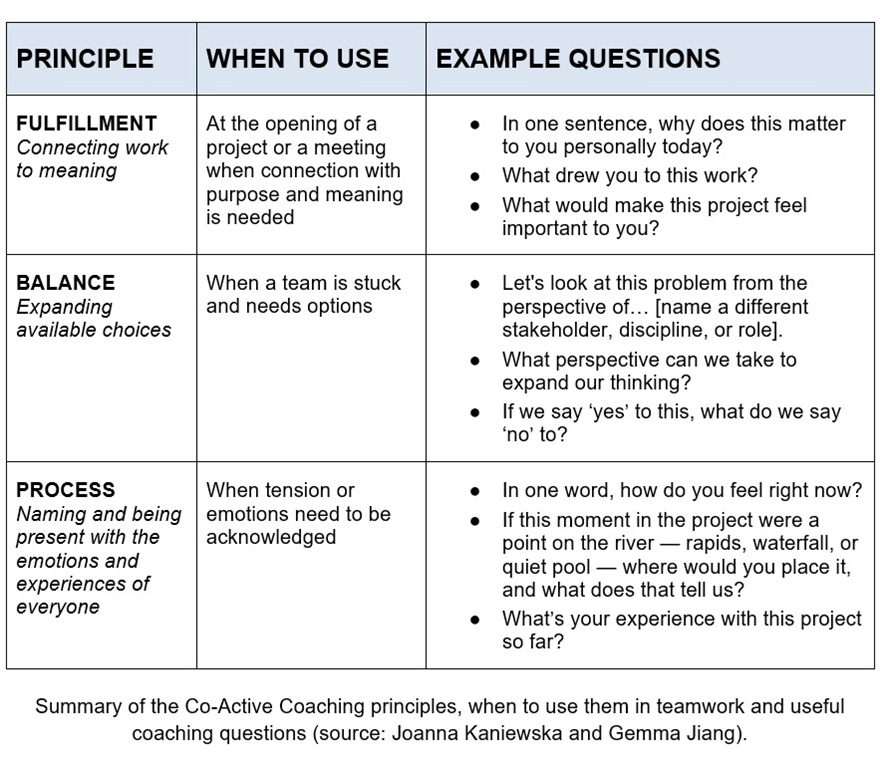
The three principles and when to use them are summarised in the table below, along with additional example coaching questions.
| PRINCIPLE | WHEN TO USE | EXAMPLE QUESTIONS |
|
FULFILLMENT |
At the opening of a project or a meeting when connection with purpose and meaning is needed |
|
|
BALANCE |
When a team is stuck and needs options |
|
|
PROCESS |
When tension or emotions need to be acknowledged |
|
Summary of the Co-Active Coaching principles, when to use them in teamwork and useful coaching questions (source: the authors). (For those using small screens, please note: this is a three column table and columns that flow off the right-hand side of the screen can be scrolled to. An image version of this table is also available).
How to use these principles
These three principles provide tools to reach for in different moments, depending on what a team needs. A well-timed fulfillment question can take as little as two minutes and can shift an entire meeting. A balance exercise can unlock creativity to tackle a conversation that has been going nowhere for months. Naming what is in the room through process coaching can transform a group’s capacity to work together. Team science practitioners can add these questions to other frameworks and facilitation techniques they already use.
Have you encountered the kinds of challenges that we outline in your research teams? How have you dealt with them? Which of the three principles — fulfillment, balance, or process — feels most relevant to the teams you work with?
Reference:
Kimsey-House, H., Kimsey-House, K., Sandahl, P. and Whitworth, L. (2018). Co-Active Coaching: The proven framework for transformative conversations at work and in life (4th ed.). Nicholas Brealey: Boston, United States of America.
This i2Insights contribution is based on an oral presentation by the two authors: Co-Active Coaching for Team Science: Building Fulfillment, Balance, and Process in Collaborative Research at the 2026 Science of Team Science Conference, Vancouver, Canada.
Use of Artificial Intelligence (AI) Statement: Anthropic’s Claude Sonnet 4.6 was used for proofreading only. (For i2Insights policy on artificial intelligence please see https://i2insights.org/contributing-to-i2insights/guidelines-for-authors/#artificial-intelligence.)
Biography: Joanna Kaniewska PhD is founder of T Shaped, a coaching and consulting practice based in New York City, New York, USA. She draws on over 15 years of experience across academia, industry, and the advocacy sector to support science leaders and teams in strengthening collaboration, communication, and decision-making through evidence-based facilitation, training and coaching.
Biography: Gemma Jiang PhD is senior team scientist at the Institute for Research in the Social Sciences (IRISS) at Colorado State University in Fort Collins, Colorado, USA. She applies complexity leadership theory, social network analysis, and a suite of facilitation and coaching methods to enable cross-disciplinary science teams to converge upon solutions for challenges of societal importance.