

By Gemma Jiang and Joanna Kaniewska.


2. Joanna Kaniewska (biography)
How can teams develop a mindset that makes differences productive, such as disciplinary differences in work processes, communication styles, underlying assumptions, behavioral norms, and more? In particular, how can teams move from an either/or mindset, which often leads to defensiveness driven by the need to prove that “I am right; you are wrong” to a both/and mindset, which fosters a learning culture in which differences become sources of generative tension that can propel creativity and collective insight?
One practical way to cultivate a both/and mindset is through working with polarities which are opposing yet interdependent tendencies. By integrating both tendencies, teams can move beyond either/or thinking and draw on a wider range of perspectives. We argue that developing the capacity to navigate polarities helps teams navigate differences more effectively overall.
In this i2Insights contribution, we describe three limiting beliefs drawn from our experience with team science coaching and show how they can be transformed through polarity thinking.
1. Limiting Belief: “If I do not defend my ideas, then I do not really mean it.”
Underneath this belief is an overattachment to advocacy and assuredness. Individuals may feel that staying firm, certain, and persuasive is necessary to demonstrate competence and commitment. This is attributable to the highly intellectual and achievement-oriented science environment where expertise and credibility are closely tied to one’s ideas.
Yet when advocacy becomes overemphasized without inquiry, and assuredness is over-practiced without openness, collaboration can become defensive and positional. Team members may spend more energy protecting their perspectives than learning from one another. Curiosity narrows, listening weakens, and opportunities for collective insight diminish.
Polarity thinking invites a more expansive stance. Rather than considering advocacy and inquiry as opposites to choose between, they are seen as interdependent tendencies that strengthen one another. The same applies to assuredness and openness. Standing firmly in a perspective does not require closing oneself off from being influenced by another. Instead, openness can allow ideas to evolve through dialogue and shared sensemaking, leading to even stronger ideas that can be held with deeper conviction.
The transformed belief—“I can stand firmly in what I believe and stay open to being changed by what I hear”—reflects a both/and mindset that supports learning, adaptability, and stronger collaboration across differences.
2. Limiting Belief: “If I give constructive feedback, then I am not nice.”
This belief commonly appears among team science practitioners who deeply value harmony, care and positive relationships. It results from an overattachment to maintaining relationships and empowerment. People operating from this mindset may avoid difficult conversations out of concern for hurting others, damaging trust, or appearing overly critical.
However, when relationship is emphasized without considering the tasks at hand and empowerment is practiced without providing direction for team members, important tensions and developmental opportunities often remain unspoken. Teams may experience unresolved frustration, unclear expectations, or reduced accountability. Over time, the absence of honest feedback can weaken collaboration.
Polarity thinking reframes this tension by recognizing that care and candor are not mutually exclusive. Honest feedback, when offered skillfully and compassionately, can be an expression of respect, investment, and commitment to another person’s growth.
The transformed belief—“I can care deeply and speak honestly so that feedback is an act of love”—reflects a both/and mindset that integrates compassion with accountability, allowing teams to build greater trust, learning, and resilience.
3. Limiting Belief: “If I tend to my own needs, then I am not leading.”
This limiting belief can occur among highly committed science leaders who consistently prioritize the needs of the group over their own. They over-identify with being supportive and indispensable, so that good leadership becomes equated with continual self-sacrifice. Attending to personal needs may then feel selfish or at odds with serving others.
While this orientation often stems from genuine care and dedication, it is rarely sustainable. In practice, such leaders burn out, while unintentionally limiting the growth and agency of their team members.
Polarity thinking reminds us that effective teams benefit not only from leaders who support and care for others, but also from leaders who are grounded, self-aware, and sustainable in their engagement. Such leaders create space for both support and challenge, encouraging team members to step into greater ownership and capacity themselves.
The transformed belief—“Self-care and service are two expressions of the same love”—reflects a both/and mindset that honors both individual wellbeing and collective contribution.
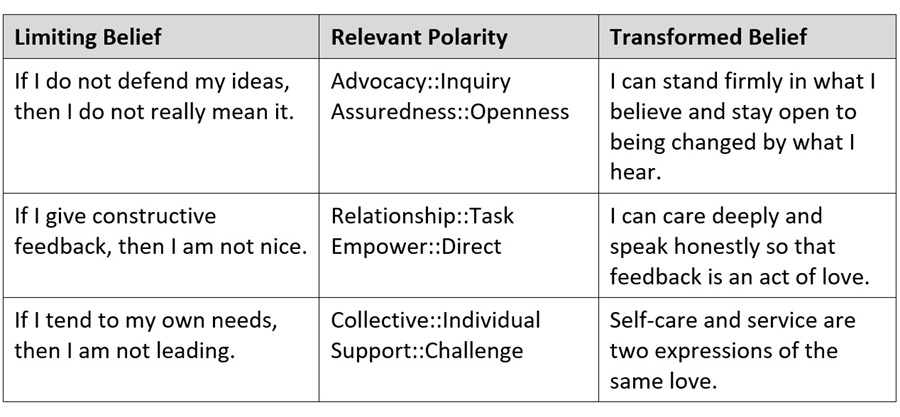
These three shifts away from limiting beliefs, as well as the relevant polarities involved, are summarized in the table below.
| Limiting Belief | Relevant Polarity | Transformed Belief |
|
If I do not defend my ideas, then I do not really mean it. |
Advocacy::Inquiry |
I can stand firmly in what I believe and stay open to being changed by what I hear. |
|
If I give constructive feedback, then I am not nice. |
Relationship::Task |
I can care deeply and speak honestly so that feedback is an act of love. |
|
If I tend to my own needs, then I am not leading. |
Collective::Individual |
Self-care and service are two expressions of the same love. |
Polarities that can transform limiting beliefs (In the table “::” is called a “paradot,” a new punctuation mark created to represent the paradoxical relationship between the two tendencies of a polarity, namely opposing and interdependent.) (For those using small screens, please note: this is a three column table and columns that flow off the right-hand side of the screen can be scrolled to. An image version of this table is also available).
Conclusion
As Niels Bohr suggested (Rozental, 1967), deep truths work differently from correct statements—they often appear as opposites, yet both may reveal essential aspects of reality. Polarity works exactly this way, with both tendencies holding important truths, and long-term success depending on the ability of teams to engage and integrate both tendencies.
What has your team’s experience been in navigating polarities? How have you and your team transformed differences from sources of defensiveness into generative tensions that foster creativity, learning, and deeper collaboration?
Reference:
Rozental, S. (Ed.). (1967). Niels Bohr: His life and work as seen by his friends and colleagues. North-Holland Publishing Company: Amsterdam, Netherlands.
Use of Artificial Intelligence (AI) Statement: OpenAI’s ChatGPT-5.5 was used to help brainstorm wording for the transformed belief statements. (For i2Insights policy on artificial intelligence please see https://i2insights.org/contributing-to-i2insights/guidelines-for-authors/#artificial-intelligence.)
Biography: Gemma Jiang PhD is senior team scientist at the Institute for Research in the Social Sciences (IRISS) at Colorado State University in Fort Collins, Colorado, USA. She applies complexity leadership theory, social network analysis, and a suite of facilitation and coaching methods to enable cross-disciplinary science teams to converge upon solutions for challenges of societal importance.
Biography: Joanna Kaniewska PhD is founder of T Shaped, a coaching and consulting practice based in New York City, New York, USA. She draws on over 15 years of experience across academia, industry, and the advocacy sector to support science leaders and teams in strengthening collaboration, communication, and decision-making through evidence-based facilitation, training and coaching.
This i2Insights contribution is based on a workshop Navigating Polarities: Developing Both/And Leadership in Team Science run by the two authors at the 2026 Science of Team Science Conference, held in May in Vancouver, Canada.
Funding Acknowledgement: This i2Insights contribution was supported, in part, by the National Center for Advancing Translational Sciences of the United States National Institutes of Health under Grant Number UM1TR004548. The content is solely the responsibility of the authors and does not necessarily represent the official views of the National Institutes of Health.