

By Andrei Savu.


Once you understand the basic concepts underpinning systems, what other concepts are key to understanding system dynamics?
While systems thinking teaches you to see and shape system structure, system dynamics focuses on understanding nonlinear behavior over time. An additional four key concepts are added to five core concepts in systems thinking described in a companion post.
The four additional key concepts for understanding system dynamics are: stocks, flows, delays and dynamic behavior patterns.
Stocks and flows
Stocks and flows are foundational concepts, essential for analyzing and designing effective systems.
A stock is an accumulation – a pool of things you can count at any instant. Stocks give systems memory and inertia.
Examples of Stocks:
- GitHub issue backlog in a repository
- Cash in a firm’s reserve account
- Inventory in a warehouse
- Knowledge in a person’s mind.
Key Characteristics of Stocks:
- Measurable: Countable at any point in time
- Memory: Represent system state and history.
Flows are rates that change stocks. Because flows are easier to adjust than stocks, quick wins often come from modifying a flow rather than rebuilding the stock.
Examples of Flows:
- Opening new issues (inflow) and closing issues (outflow) in GitHub
- Revenue (inflow) and expenses (outflow) affecting cash
- Products arriving at and leaving a warehouse.
Key Characteristics of Flows:
- Rate-based: Measured per unit of time
- Direction: Can increase (inflow) or decrease (outflow) a stock.
The relationship between stocks and flows
Stocks and flows are interdependent parts of a system:
- A stock can only be changed by its inflows and outflows
- The level of a stock can influence its flows through feedback
- Changes in flows produce gradual changes in stocks, creating delays.
Understanding stocks and flows provides powerful insights:
- To change a stock quickly, adjust both inflows and outflows
- Small persistent flow changes can produce large stock changes over time.
Delays
Delays are critical elements in systems that create gaps between actions and their consequences. Understanding delays helps explain oscillations, overshoots, and the challenges of managing complex systems.
Types of delays:
- Transport Delays: occur when material or information physically moves through space. The time required depends on distance and the medium of transport.
- Information Delays: happen when data about system conditions takes time to be collected, processed, and distributed to decision-makers.
- Decision Delays: occur between receiving information and taking action, often due to analysis, approval processes, or hesitation.
Dynamic behavior patterns
Systems reveal themselves through patterns that repeat across vastly different domains. Recognizing these signature behaviors—from exponential growth to overshoot and collapse—provides predictive power that transcends specific contexts and builds intuition for complex system dynamics.
Understanding common patterns of system behavior helps us recognize, predict, and influence how systems change over time. These patterns emerge repeatedly across diverse contexts – from business growth to pandemic spread, from learning curves to resource depletion.
These patterns are the crystallized fingerprints of systems – where stocks, flows, feedback loops, and delays combine to create recognizable signatures. By learning to spot these patterns, you gain the ability to anticipate a system’s trajectory before it fully unfolds.
Exponential growth:
- Structure: A stock that increases its own inflow rate through a reinforcing feedback loop. Each addition to the stock accelerates the inflow, creating a self-amplifying cycle.
- Behavior: Exponential growth occurs when a system’s rate of change increases in proportion to its current value. The classic example is compound interest, where money earns interest, which then earns more interest. In the early stages, growth appears deceptively slow, but as the base expands, the absolute change per time period accelerates dramatically.
- This pattern appears whenever success breeds more success through reinforcing feedback. The key insight: exponential systems spend most of their visible growth history in accelerating growth, making them particularly challenging to manage once they gain momentum.
Goal-seeking decay:
- Structure: A balancing loop that reduces the gap between current state and target. The flow rate adjusts proportionally to the distance from the goal, creating a self-correcting process.
- Behavior: Goal-seeking decay appears when a system works to eliminate the discrepancy between its current state and a desired state. The correction rate is proportional to the remaining gap – large gaps trigger strong responses, while smaller gaps generate weaker adjustments.
- This results in rapid initial progress that progressively slows as the system approaches its goal. The balancing feedback creates a characteristic curve where the largest gains come early, with each subsequent time period producing smaller absolute changes.
Overshoot-and-collapse:
- Structure: A reinforcing growth loop connected to a delayed balancing loop that erodes carrying capacity. The delay in feedback prevents timely correction, allowing growth to exceed sustainable limits.
- Behavior: Overshoot-and-collapse occurs when rapid growth continues beyond sustainable levels, eventually triggering a system crash. The pattern emerges when a reinforcing growth loop operates without timely feedback about approaching limits, often due to delays in perceiving or responding to warning signs.
- This dynamic explains boom-bust cycles in financial markets, population crashes in predator-prey relationships, and the rise and fall of organizations. The significance of this pattern lies in its preventability – early warning systems and proactive constraint management can transform potential collapse into sustainable equilibrium.
S-curve saturation:
- Structure: Initial reinforcing growth loop that gradually shifts dominance to a balancing constraint loop. The transition between loop dominance creates the characteristic sigmoid shape.
- Behavior: The S-curve combines early exponential growth with eventual saturation. Initially, reinforcing feedback drives accelerating growth, but as the system approaches its carrying capacity, balancing loops become dominant, gradually slowing growth until the system stabilizes at a new equilibrium.
- This pattern governs technology adoption cycles, species population in constrained environments, and market penetration processes. The S-curve represents successful adaptation to environmental limits without system collapse, often through the gradual transition from growth-focused to efficiency-focused strategies as maturity approaches.
System archetypes
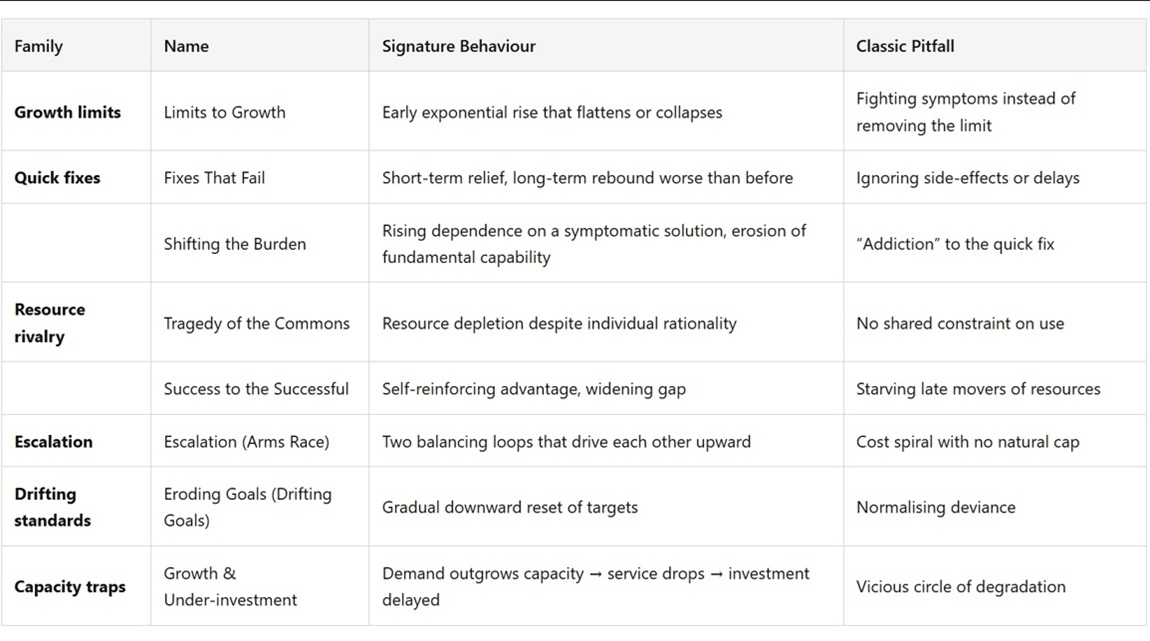
System archetypes are recurring structural patterns—combinations of stocks, flows, feedback loops, and delays—that generate familiar behaviours across wildly different domains. Spotting an archetype lets you skip exhaustive data gathering and move straight to high leverage interventions.
Whereas the section above on Dynamic Behaviour Patterns shows what curves appear (S-curves, overshoot and collapse, etc.), archetypes explain why they appear and where to intervene. They are one step closer to the blueprint of a system.
An overview of classic system archetypes is shown in the four-column table below.
Family
Name
Signature Behaviour
Classic Pitfall
Growth limits
Limits to Growth
Early exponential rise that flattens or collapses
Fighting symptoms instead of removing the limit
Quick fixes
Fixes That Fail
Short-term relief, long-term rebound worse than before
Ignoring side-effects or delays
Shifting the Burden
Rising dependence on a symptomatic solution, erosion of fundamental capacity
’Addiction’ to the quick fix
Resource rivalry
Tragedy of the Commons
Resource depletion despite individual rationality
No shared constraint on use
Success to the Successful
Self-reinforcing advantage, widening gap
Starving late movers of resources
Escalation
Escalation (Arms Race)
Two balancing loops that drive each other upward
Cost spiral with no natural cap
Drifting standards
Eroding Goals (Drifting Goals)
Gradual downward reset of targets
Normalising deviance
Capacity traps
Growth and Under-investment
Demand outgrows capacity > service drops > investment delayed
Vicious circle of degradation
An overview of classic system archetypes (Source: author; adapted from system dynamics core texts eg Kim (1992, 2000)). (For those using small screens, please note: this is a four column table and columns that flow off the right-hand side of the screen can be scrolled to. An image version of this table is also available).
1. Limits to Growth
Structure: A reinforcing loop drives growth until a balancing loop—often delayed—kicks in as some “carrying capacity” is approached.
Behaviour: S-curve saturation or, if the balancing correction is too slow, overshoot and collapse.
Leverage Points:
- Remove or raise the limiting factor (eg., add production lines).
- Speed up the balancing feedback so action starts sooner (ie., shorter information delay).
2. Fixes that Fail
Structure: Balancing loop with a quick symptomatic fix. A side effect (reinforcing loop) undermines the system later.
Behaviour: Initial improvement followed by equal or worse relapse.
Leverage Points:
- Address the underlying cause rather than symptoms.
- Surface delayed side effects (eg., information flow).
3. Shifting the Burden
(A cousin of Fixes That Fail in which the quick fix becomes addictive.)
Structure: Two balancing loops compete:
- Fundamental Solution (slow).
- Symptomatic Solution (fast) that also erodes the capability to deliver the fundamental one.
Behaviour: Growing dependency on the quick fix; declining core capability.
Leverage Points:
- Invest in the fundamental solution early.
- Limit or phase out the symptomatic response.
4. Tragedy of the Commons
Structure: Multiple actors draw from a shared stock. Each reinforcing loop benefits the individual; a single balancing loop (resource depletion) is global and delayed.
Behaviour: Aggregate extraction overshoots renewal, leading to resource collapse.
Leverage Points:
- Align individual incentives with collective health (quotas, pricing, tradable permits).
- Improve visibility of the shared stock level.
5. Success to the Successful
Structure: Two (or more) actors compete for a shared inflow of resources. Small early advantage loops back to secure even more resources.
Behaviour: Divergence; winner take all.
Leverage Points:
- Cap the reinforcing advantage (eg., progressive taxation on resources).
- Guarantee baseline access for lagging actors.
6. Escalation (Arms Race)
Structure: A balancing loop in System A sets a target relative to System B, and vice versa. Each action is a negative reference for the other.
Behaviour: Spiral of ever increasing effort, cost, or aggression; potential sudden collapse when one party can’t keep up.
Leverage Points:
- Break the relative reference (ie., treat own performance as absolute).
- Introduce an external limit (eg., treaty, budget cap).
7. Eroding Goals (Drifting Goals)
Structure: Discrepancy between desired state and actual state is corrected not only by acting on the real system but also by lowering the goal itself.
Behaviour: Gradual performance decay masked by slipping standards.
Leverage Points:
- Fix the reference point (ie., hard targets).
- Track and publish gap over time to expose drift.
8. Growth and Under-investment
Structure: Reinforcing growth drives demand. Investment in capacity is governed by a balancing loop with delay. If service quality drops, demand slows, cutting appetite for new investment – a vicious circle.
Behaviour: Boom stall or boom bust depending on delay length.
Leverage Points:
- Invest ahead of demand using leading indicators.
- Reduce investment delays (eg., prefabricate capacity, flexible staffing).
Conclusion
As you may see, system dynamics concepts not only allow analysis of existing—often problematic—situations, but also provide simulation tools to test ideas before reality does. Do these concepts resonate with you? Do you have examples to share of effective use of system dynamics analysis or testing?
To find out more:
Savu, A. (2025). Teach Yourself Systems. Teach Yourself Systems website. (Online): https://teachyourselfsystems.com/
This interactive learning resource also provides examples, models and quizzes. Much of this i2Insights contribution is taken verbatim from this resource.
Reference:
Kim, DH (1992, 2000) Systems archetypes I: Diagnosing systemic issues and designing high-leverage interventions. The Toolbox Reprint Series. Pegasus Communications, Inc: Waltham, MA, USA.
Use of Generative Artificial Intelligence (AI) Statement: Teach Yourself Systems (TYS) was built with a lot of artificial intelligence assistance – both content wise and from a coding perspective. Most of the code has been written by OAI Codex with some help from Devin early on. A lot of brainstorming on various topics was done with o3 Pro. (For i2Insights policy on generative artificial intelligence please see https://i2insights.org/contributing-to-i2insights/guidelines-for-authors/#artificial-intelligence.)
Biography: Andrei Savu builds data and artificial intelligence (AI) systems and created Teach Yourself Systems (TYS), an interactive site that helps practitioners learn systems thinking and system dynamics through hands on models and examples. He believes that in a world of abundant intelligence, systems thinking is becoming more important than ever. His interests include AI agents, data platforms, and turning systems concepts into practical tools people can use every day. He is based in Menlo Park, California, USA.