

By Benjamin Hofmann and Milena Wiget.


2. Milena Wiget (biography)
What options do researchers have in designing interdisciplinary collaborations? How can researchers understand the connections between their own discipline-based research and less familiar research in other disciplines?
Types of interdisciplinary research collaborations
Solving complex sustainability and other problems often requires the integration of different disciplinary perspectives, which is challenging. To address this challenge, we developed a simple typology that features three types of interdisciplinary research collaborations, which can be implemented at any stage of the research process, as described, and shown in the figure, below.
Common base (type I): Research from different disciplines is integrated at one stage of the research process and then separated into disciplinary research at the next stage. An example is the formulation of an integrated research question and of joint hypotheses that guide interdisciplinary collaboration, which is then followed by the development of different disciplinary instruments of data collection. For example, historians may then perform text analysis, sociologists may conduct surveys, and epidemiologists may undertake health exposure measurements.


Common destination (type II): Separate disciplinary research at one stage of the research process is followed by integration across disciplines at the next stage. For example, data that have been collected using different instruments and disciplinary approaches (eg., interviews undertaken by anthropologists and surveys for different parts of the population undertaken by psychologists) are later analyzed and discussed across disciplines using a joint set of methods and reflection questions.
Sequential link (type III): Completed research from one discipline serves as the basis for a new research process in another discipline. For instance, findings of a qualitative study with a small number of participants in one discipline (eg., a study by agronomists on farming practices) can provide the starting point for a new large-scale quantitative study in another discipline (eg., a study of farmer behavior by agroeconomists).
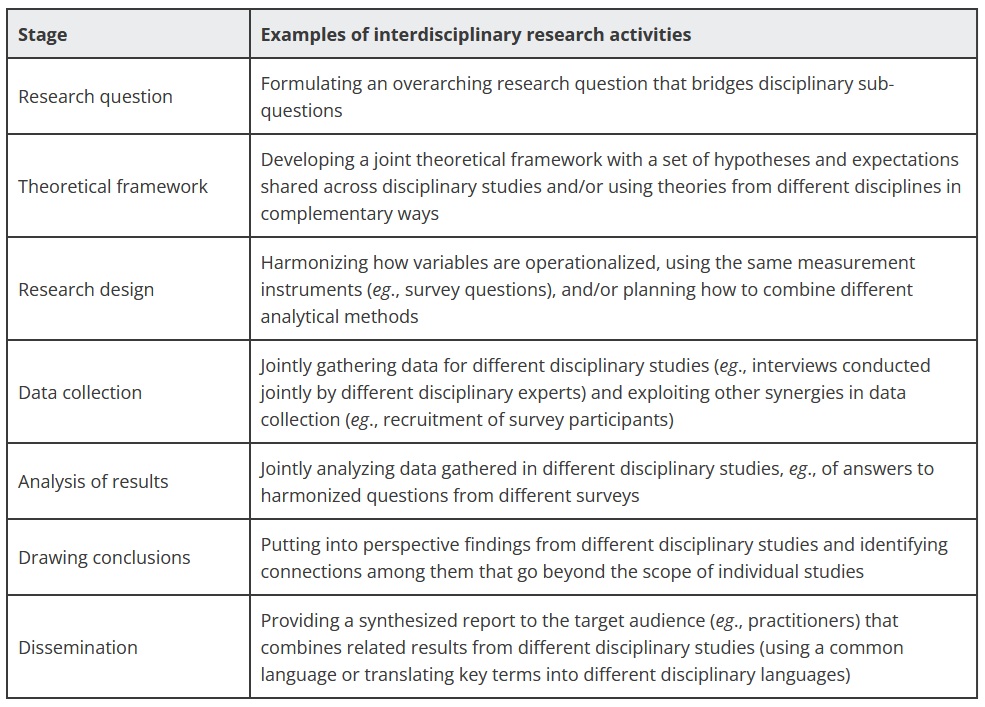
Fundamental to the typology is that, in principle, interdisciplinary integration can occur at any stage of the research process, as illustrated in the table below. The stages and examples in the table reflect an empirical research process and would look different for other types of research processes.
Stage
Examples of interdisciplinary research activities
Research question
Formulating an overarching research question that bridges disciplinary sub-questions
Theoretical framework
Developing a joint theoretical framework with a set of hypotheses and expectations shared across disciplinary studies and/or using theories from different disciplines in complementary ways
Research design
Harmonizing how variables are operationalized, using the same measurement instruments (eg., survey questions), and/or planning how to combine different analytical methods
Data collection
Jointly gathering data for different disciplinary studies (eg., interviews conducted jointly by different disciplinary experts) and exploiting other synergies in data collection (eg., recruitment of survey participants)
Analysis of results
Jointly analyzing data gathered in different disciplinary studies, eg., of answers to harmonized questions from different surveys
Drawing conclusions
Putting into perspective findings from different disciplinary studies and identifying connections among them that go beyond the scope of individual studies
Dissemination
Providing a synthesized report to the target audience (eg., practitioners) that combines related results from different disciplinary studies (using a common language or translating key terms into different disciplinary languages)
(For those using small screens, please note: this is a two column table and columns that flow off the right-hand side of the screen can be scrolled to. An image version of this table is also available.)
Reflections on applying the typology
Our experience in applying the typology is that:
- The different types of interdisciplinary collaboration are like puzzle pieces that can be combined.
- Reflecting on collaboration types helps research teams address opportunities and challenges of interdisciplinary research early in the research process.
- Each collaboration type presents its own challenges. For example:
- in a Type I collaboration, it takes time and effort to establish common ground among involved researchers in terms of concepts and terminology.
- in a Type II collaboration, integration of building blocks from different disciplines requires ex-post reconciliation of different concepts or methods.
- in a Type III collaboration, timely delivery of results is challenging due to the sequential nature of the research.
- Research projects are often divided into work packages. Adopting interdisciplinary collaborations helps everyone involved to maintain an overview of who is doing what, when, and how.
- It is not easy to achieve a good balance between the different disciplinary and interdisciplinary aims of individual research group members. This requires regular and, ideally, facilitated meetings that allow for negotiation, learning and agreement among researchers.
- Breaking down interdisciplinary research into a set of different collaborations can alleviate the fears of researchers who (mistakenly) expect an all-encompassing synthesis at the end of the research.
- The three types of collaborations are useful for mapping the integration process retrospectively and for identifying missed opportunities for integration.
Concluding questions
How do the three ways to design interdisciplinary collaborations resonate with your experiences? Could they help you design interdisciplinary research in a clear and conscious way? Do you see additional types of collaborations? Do you think that some types are more appropriate than others in different contexts? What other application challenges can you see?
To find out more:
Hofmann, B., Reber, U., Ammann, P., Dötzer, J., Mark, J., McCallum, C., Wiget, M. and Zachmann, L. (2025). A typology of interdisciplinary collaborations: Insights from agri-food transformation research. Sustainability Science, 20: 1791-1808. (Online – open access) (DOI): https://doi.org/10.1007/s11625-025-01702-x
Use of Generative Artificial Intelligence (AI) Statement: Generative artificial intelligence was not used in the development of this i2Insights contribution. (For i2Insights policy on generative artificial intelligence please see https://i2insights.org/contributing-to-i2insights/guidelines-for-authors/#artificial-intelligence.)
Biography: Benjamin Hofmann PhD is a Group Leader at TdLab, Department of Environmental Systems Science, ETH Zurich, and an academic guest at Eawag, the Swiss Federal Institute of Aquatic Science and Technology. His research is located in the field of inter- and transdisciplinary sustainability science, with a focus on the role of knowledge in environmental governance.
Biography: Milena Wiget PhD is a research associate at the Institute of Political Science, University of Bern, and an academic guest at Eawag, the Swiss Federal Institute of Aquatic Science and Technology. Her research interests include socio-environmental problems and related decision-making and policy processes. In her research, she applies concepts and methods from multicriteria decision analysis and policy studies, drawing on her background in environmental sciences.